Behind the Canvas: Fusing Armenian Typography with Generative Web Math
From tactile kitchen fridge magnets to a global digital-to-print composition engine: How PROPER Studios built a tool that empowers non-native designers to engage deeply with ancient Armenian glyphs without falling into cultural caricature.
Peno Mishoyan • Creative Director, PROPER Studios and Kaizen Dale
Published July 2026 • 8 min read
The Armenian alphabet has a visual character all its own. Its glyphs follow a unique rhythm shaped across 1,600 years of cultural and artistic tradition.
When we set out to build Zanazan GlyphGarden, our mission was simple: transform these centuries-old forms into an interactive, digital-to-print canvas that allows anyone—from native speakers to international designers—to compose high-end artwork while respecting cultural integrity.
The 10-Year Evolution: From Fridge Magnets to Canvas Math
A decade ago, Zanazan began as a tactile physical product: sets of Armenian letter magnets crafted for everyday kitchen fridges. Freinds and families moved the pieces around, forming names, proverbs, and poetry across kitchen surfaces worldwide. That small physical object proved something crucial: people crave tangible, playful interaction with heritage script.
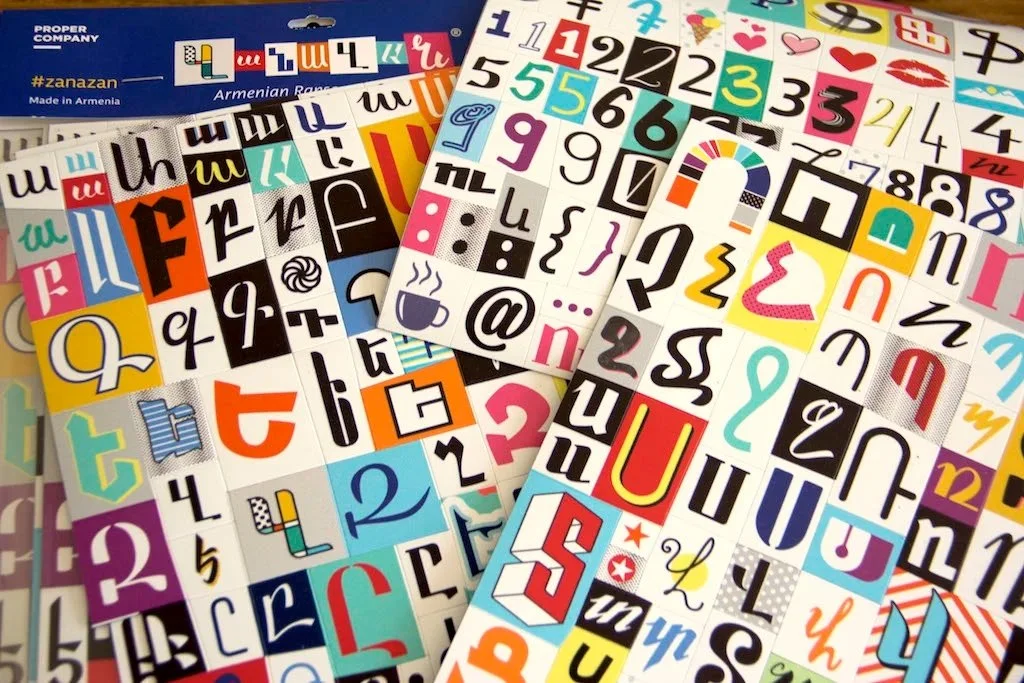
Phase 1: Zanazan magnet sheets, 2016
Phase 2: A glimpse into the app’s process.
Bringing that tactile experience into the web browser presented a unique engineering challenge. How do you digitize 330+ intricate vector characters—spanning bird calligraphy, floral scrollwork, and geometric cuts—while retaining the tactile joy of physical play?
2. The Armenian Typographic Renaissance & The Visual Melting Pot
It’s been quite a while witnessing a global Armenian typographic renaissance. Driven by international platforms like the Granshan non-Latin type competition, alongside groundbreaking contemporary designers such as Gayane Yerkanyan, Khajag Apelian, Ruben Malayan, and many others, Armenian letterforms are being pushed out of museum cases and into avant-garde modernist territories.
“Zanazan functions as a visual melting pot where 1600-year-old bird calligraphy and 20th-century constructivist forms coexist on a single canvas."
Our goal with Zanazan GlyphGarden is to create a generative playground. By curating historical cuts alongside modernist interpretations, Zanazan creates a space for cultural continuity—proving that centuries-old forms can comfortably anchor contemporary interior design and physical goods.
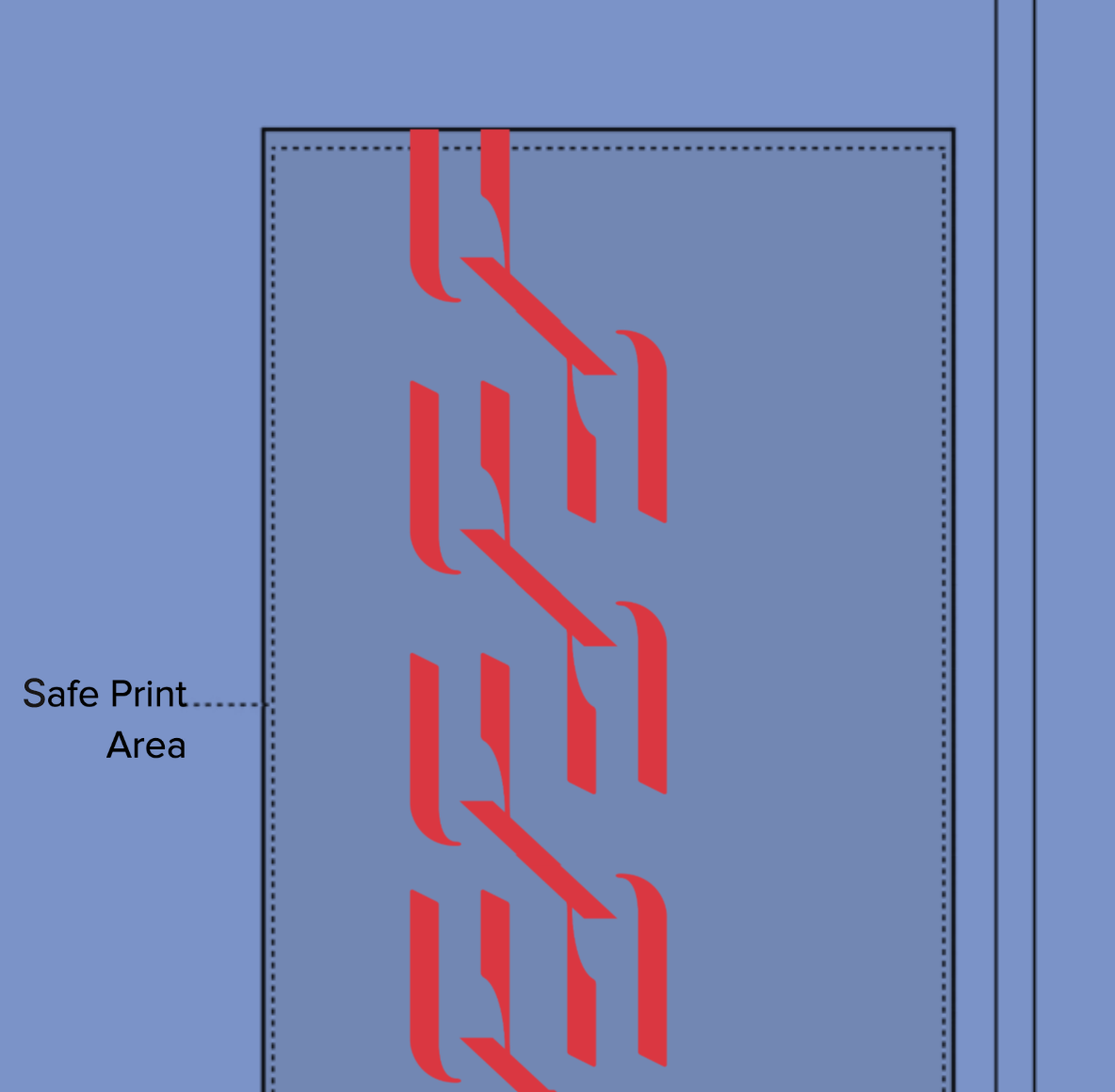
A snapshot of the product canvas with its print‑safe guides visible.
3. Making Graphic Composition Accessible to Non‑Designers
For many people, Armenian glyphs feel hard to approach because traditional tools require vector skills. Zanazan removes that barrier, making it easy for anyone to explore and compose with the forms naturally.
A. Curing Blank-Canvas Paralysis
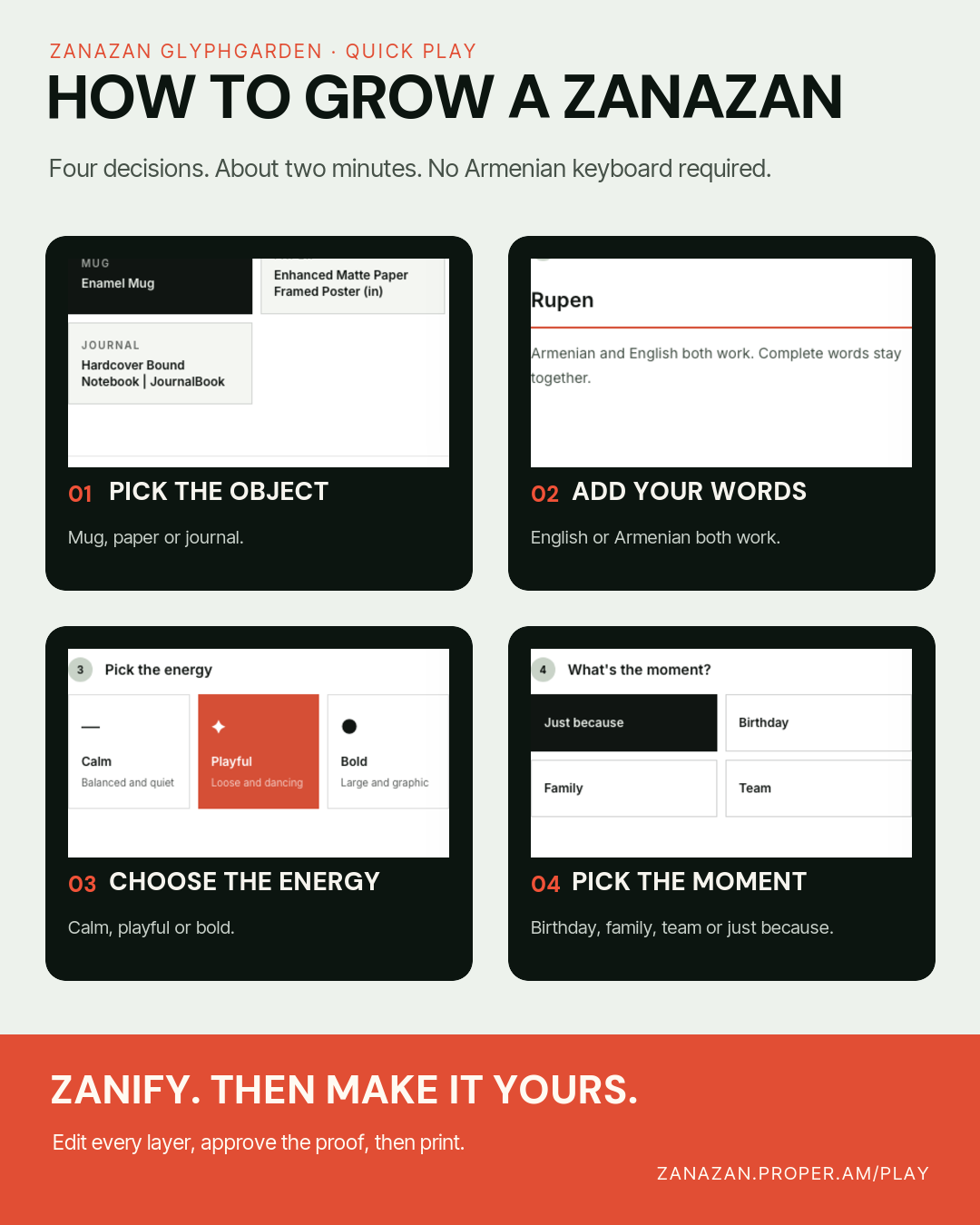
Starting with an empty artboard is hard. Through Quick Play, non-designers get immediate, visually balanced starting points ("blooms") that look great right away, giving them the confidence to tweak, rotate, and make the piece their own.
B. Modular Vector Play
Every glyph is pre-optimized as a clean, modular design object. Users can drag, rotate, scale, and layer characters effortlessly—treating ancient letterforms with the same intuitive freedom as building blocks.
C. Frictionless Physical Output
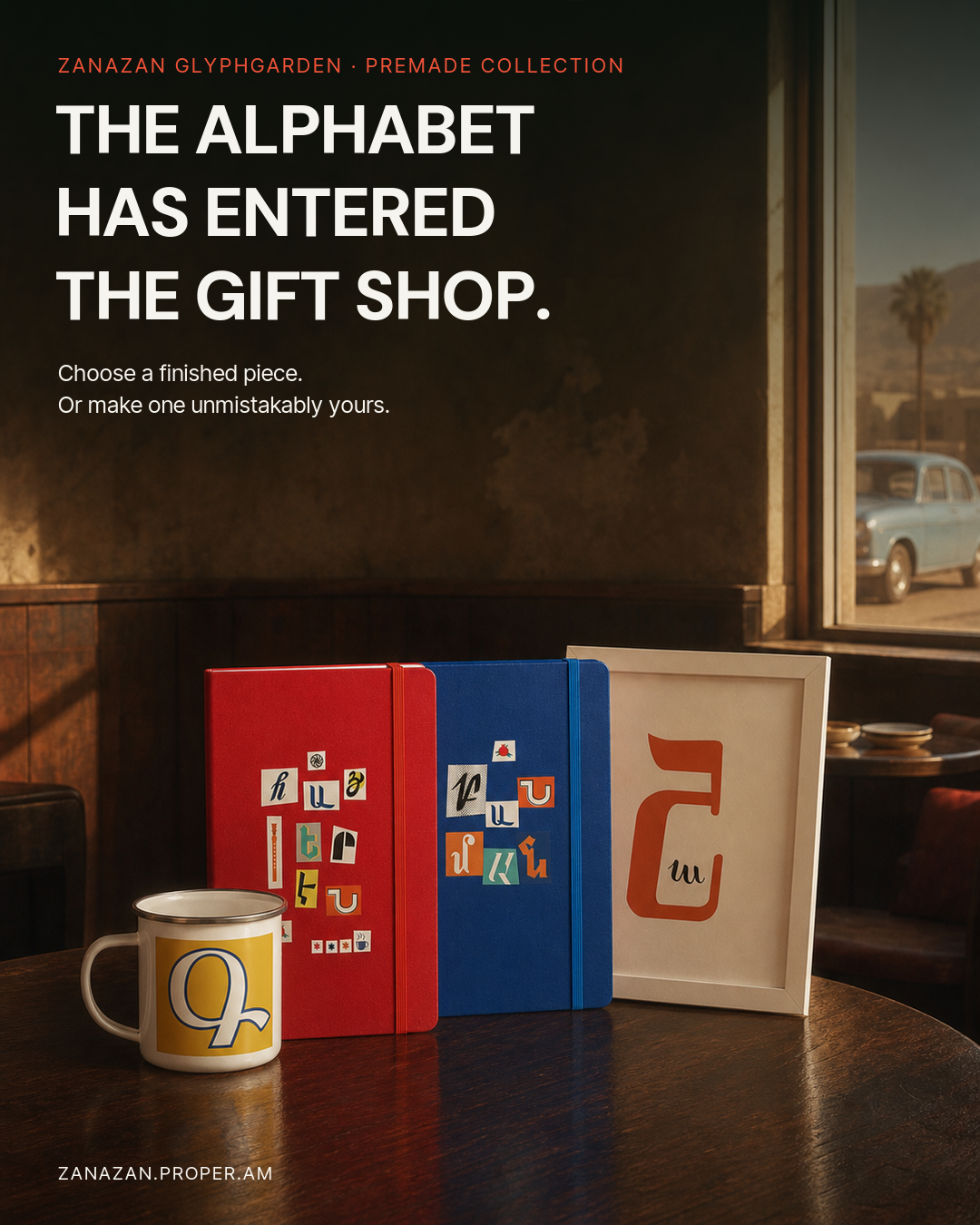
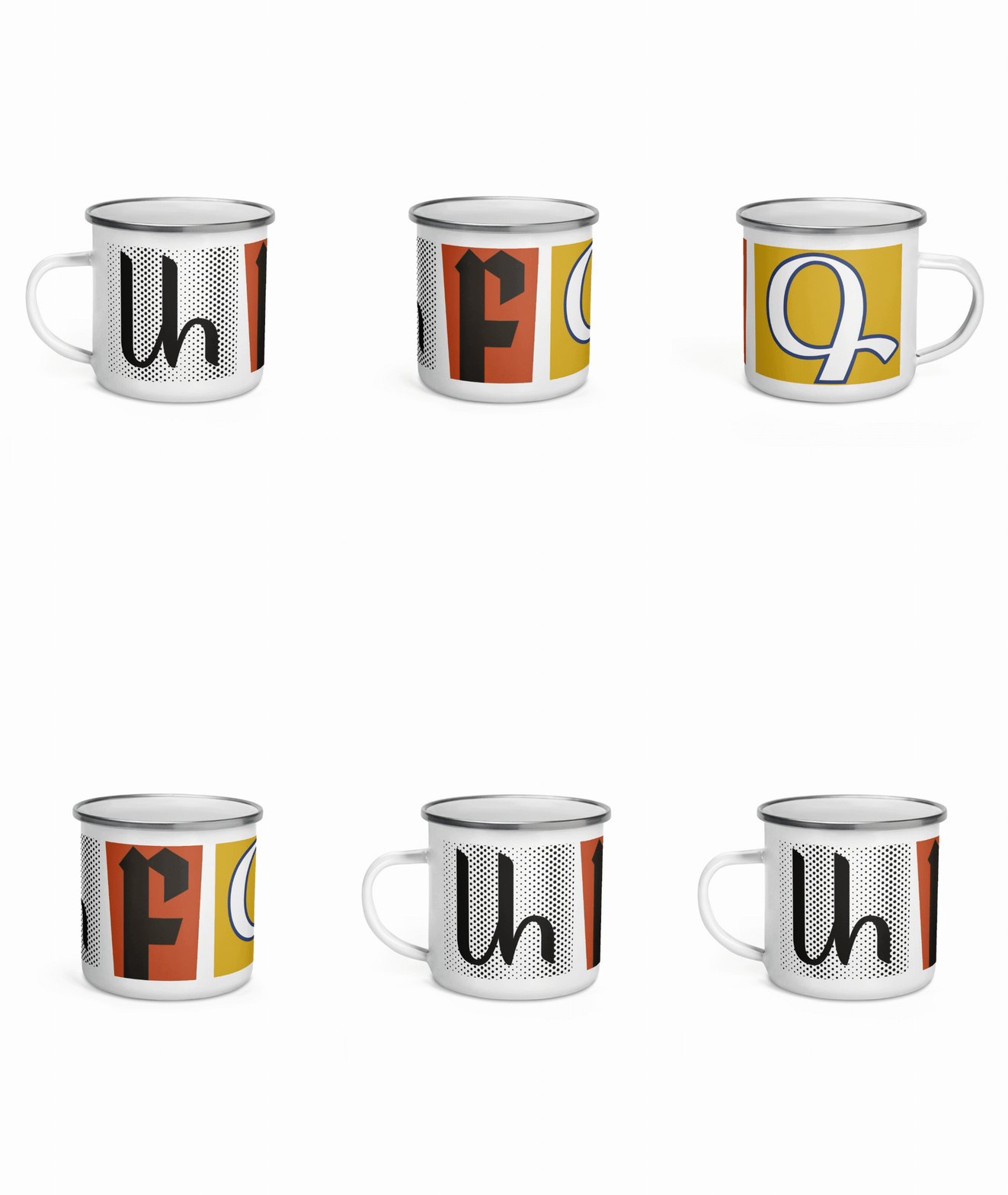
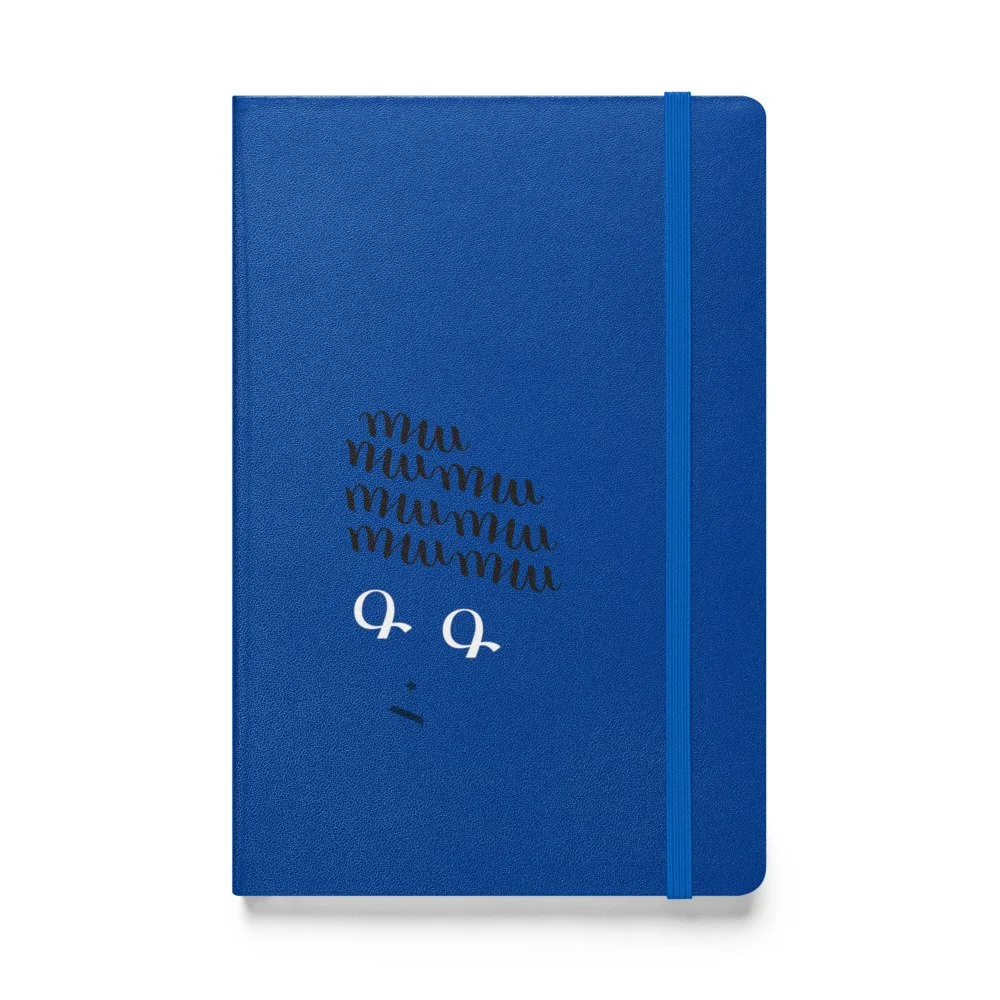
Non-designers don't need to understand print bleeds, resolution, or vector rasterization. The app automatically translates digital compositions into production-ready physical goods (journals, posters, mugs) that arrive looking exactly like the proof.
4. Dual-Engine Architecture & Production-Grade Rigor
To balance complete creative freedom with production reliability, we architected Zanazan around a dual-engine workflow:
Quick Play Engine: A 3-step guided generator (Word, Energy, Occasion) that generates deterministic, beautifully balanced vector compositions in seconds.
Advanced Studio Canvas: A full precision editor for professional designers to adjust layer hierarchy, rotation, scaling, and custom glyph placement without flattening layers.
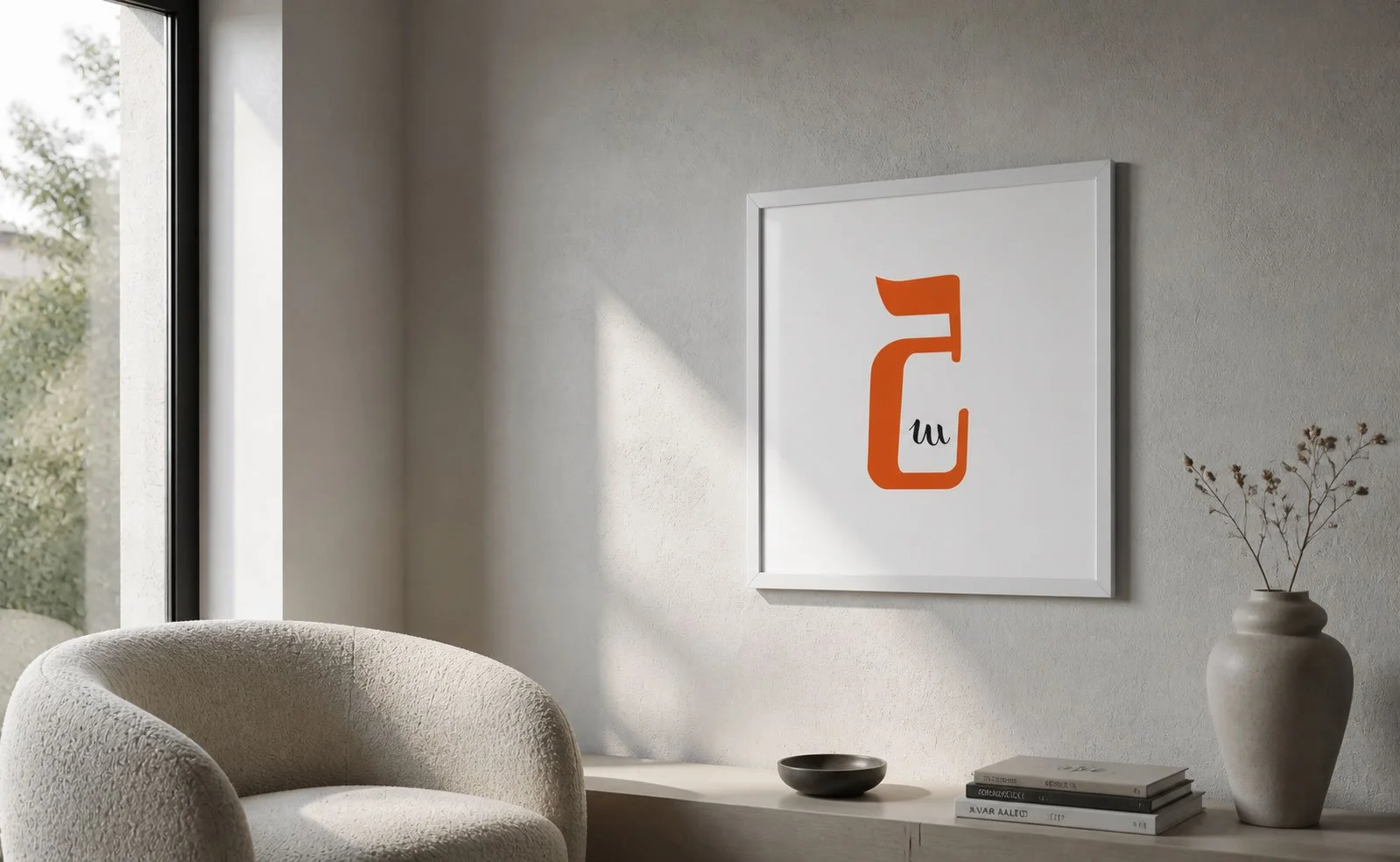
Handling Product Proportions & Print Exports
Designing across different items means dealing with different shapes and aspect ratios—a layout built for a square poster won't automatically fit a tall journal or a curved mug.
To solve this, Zanazan uses a normalized coordinate system with item-specific print bounds. This keeps compositions centered and properly proportioned no matter which product the user chooses. When a design is ready, our backend renders a 300 DPI print-ready file sent directly to fulfillment.
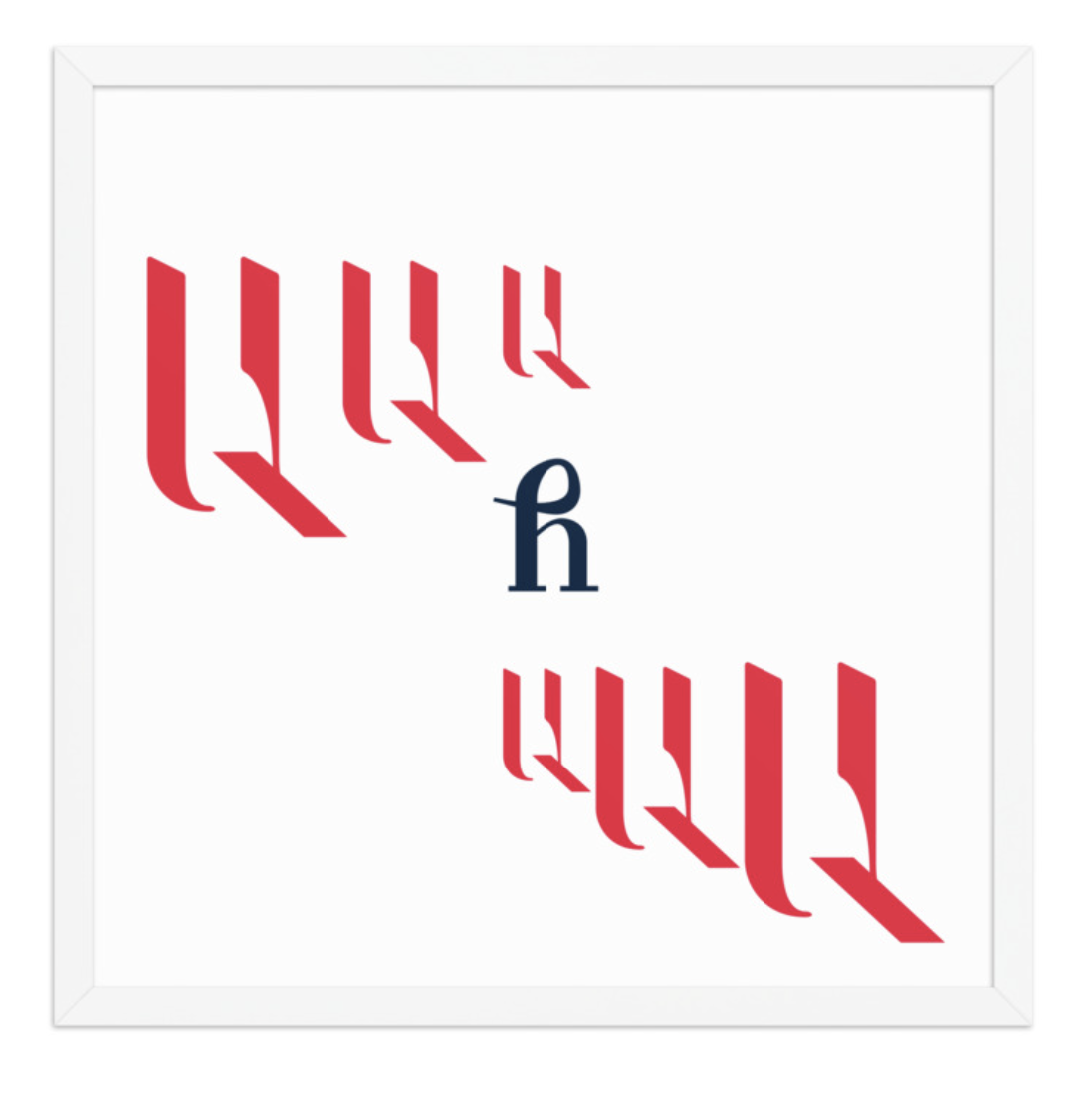
5. Key Insights & Takeaways
Curated Starts > Blank Canvases: Blank screens paralyze non-designers. By offering guided starting points ("blooms"), users get an instant visual anchor they can immediately tweak, rotate, and personalize.
Layout Math Protects Print Quality: Designing across different physical products (posters, notebooks, mugs) requires strict proportional bounds and safe print margins, ensuring whatever is composed on screen translates cleanly to physical production.
Heritage Thrives on Play: Giving people interactive digital and physical tools to play with traditional scripts brings culture into everyday life.
The first promo video for the app’s launch.